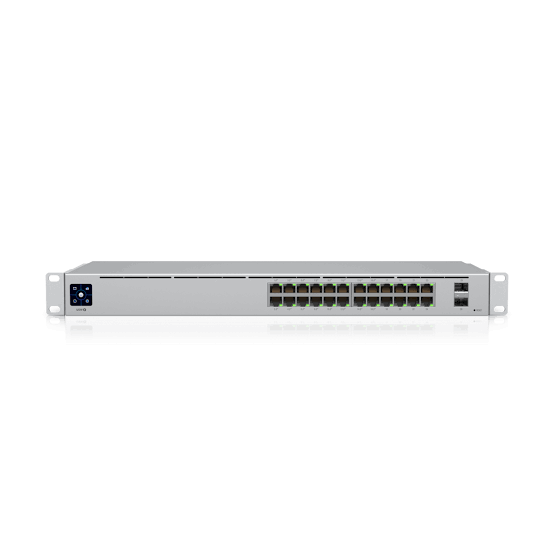
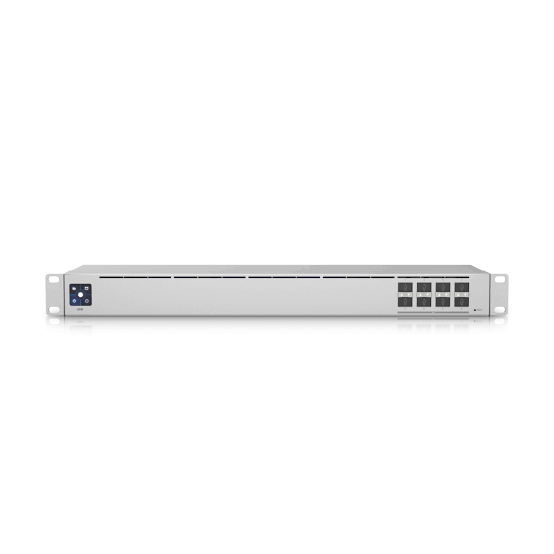
The Ubiquiti UniFi USW-Aggregation is a fully managed Layer 2 switch with eight 10G SFP+ ports. It sits at the core of a UniFi network. Its job is to collect high-speed uplinks from access switches, servers, storage, and routers into one fibre backbone.
In practical terms, the USW-Aggregation lets you connect up to eight 10G links at full speed. It offers 160 Gbps of switching capacity and 80 Gbps of non-blocking throughput. As a result, every port can run at line rate at the same time.
What the USW-Aggregation Does in a Network
Most growing networks start with one router and one switch. Later, more PoE switches are added for cameras, Wi-Fi access points, and IP phones. Each of those switches needs an uplink. Consequently, the core becomes a bottleneck.
The USW-Aggregation solves this problem. Instead of daisy-chaining switches over 1G copper, each access switch gets its own 10G SFP+ uplink back to the aggregation layer. Therefore, traffic between floors, buildings, or racks moves at 10 Gbps rather than 1 Gbps.
In addition, the switch supports LACP port aggregation. You can bond two or more SFP+ ports into a single logical link. This adds bandwidth and also provides a backup path if one cable or module fails.
Eight 10G SFP+ Ports with 1G Backward Compatibility
The USW-Aggregation has eight SFP+ cages. Each port runs at 10 Gbps or 1 Gbps. This means you can mix new 10G fibre runs with older 1G SFP modules during a phased upgrade.
Furthermore, the ports accept a wide range of media:
- Multi-mode fibre modules for short runs inside a building or server room
- Single-mode fibre modules for long runs between buildings or across a campus
- DAC (direct attach copper) cables for short, low-cost links between racks
- 10G RJ45 copper modules for connecting to existing Cat6/Cat6A cabling
Ubiquiti’s own datasheet lists support for up to eight UACC-OM-MM-10G or UACC-OM-SM-10G optical modules. Note that 10G RJ45 copper modules draw more power and run hotter than optical modules, so the number you can install is limited (see the specifications below).
Switching Performance and Throughput
The USW-Aggregation is built around full line-rate switching. Here is what the figures mean in practice:
- 160 Gbps switching capacity. This is eight ports × 10 Gbps × 2 (full duplex). The switch can send and receive at full speed on every port at once.
- 80 Gbps non-blocking throughput. No port has to wait for another. Consequently, a large file copy to a NAS will not slow down camera uplinks on other ports.
- 119 Mpps forwarding rate. This covers small-packet traffic such as VoIP and CCTV control streams without dropped frames.
- 1.5 MB packet buffer. The buffer absorbs short traffic bursts, for example when several cameras push video at the same moment.
- 16,000-entry MAC address table. This is enough for several hundred users, cameras, and IoT devices across the downstream switches.
Layer 2 Management and Security Features
Although the USW-Aggregation is a Layer 2 switch, it carries a full set of managed features. In other words, routing between VLANs is handled by your UniFi gateway, while the switch handles segmentation, filtering, and traffic control.
Key features include:
- Up to 1,000 VLANs and Voice VLAN for separating staff, guest, CCTV, and VoIP traffic
- LACP link aggregation for bonded, redundant uplinks
- STP and RSTP with loop protection to stop broadcast storms from cabling mistakes
- IGMP snooping with querier, fast leave, and router port settings for multicast video
- 802.1X control for port-based network access
- DHCP snooping and guarding to block rogue DHCP servers
- MAC-based and IP-based ACLs (128 entries each) with device and network isolation
- Port isolation, port mirroring, and MAC-based port restriction
- Storm control, egress rate limiting, flow control, and multicast/broadcast rate limiting
- Jumbo frames for storage and backup traffic
- LLDP-MED for automatic phone and device discovery
Managed Through UniFi Network
The USW-Aggregation is configured and monitored from the UniFi Network application (version 5.14.12 and later). Once adopted, it appears alongside your gateway, access points, and other UniFi switches in one dashboard.
From there, you can set VLANs, create port profiles, view per-port traffic, and push firmware updates. Moreover, the same controls are available in the UniFi mobile app. This is useful when you manage several client sites and need to check status remotely.
Additionally, the front panel has a 1.3″ colour touchscreen. It shows the switch’s adoption state, IP address, and port activity at a glance. Status LEDs confirm boot progress, firmware upgrades, and adoption.
Fanless, Compact, and Low-Power Design
The USW-Aggregation is fanless. As a result, it runs silently, which suits offices, reception areas, and small comms cabinets where fan noise is a problem.
At the same time, the chassis is only 120 mm deep. This means it fits shallow wall-mount racks and SOHO cabinets, not only full-depth server racks. The supplied rack ears support rack depths from 400 mm to 1,200 mm.
Power draw is also modest. Maximum consumption is 36W including SFP modules, and heat output is 102 BTU/hr. For Kenyan sites that rely on a UPS or inverter during KPLC outages, this low draw helps extend backup runtime for the network core.
However, note that the USW-Aggregation has a single internal power supply. It has no redundant PSU input. Therefore, we recommend connecting it to a UPS to protect against power cuts and surges.
Build Quality and Environmental Ratings
The enclosure is made from SGCC galvanised steel. It carries ESD protection rated at ±16 kV air and ±12 kV contact discharge.
The USW-Aggregation is rated for ambient temperatures from -5°C to 40°C and 10–90% non-condensing humidity. Because it has no fan, it relies on passive cooling. For this reason, leave some airflow around the unit, especially in warmer coastal locations such as Mombasa.
USW-Aggregation vs. USW-Pro-Aggregation
Buyers often compare the USW-Aggregation with the larger USW-Pro-Aggregation. The two models serve different network sizes:
- USW-Aggregation: 8 × 10G SFP+, Layer 2, 160 Gbps, fanless, 120 mm deep, 36W
- USW-Pro-Aggregation: 28 × 10G SFP+ plus 4 × 25G SFP28, Layer 3, 760 Gbps, 325 mm deep, 100W, with redundant power input
In short, the USW-Aggregation fits small and mid-sized networks with up to eight 10G uplinks. Larger sites that need more ports, 25G links, or Layer 3 routing at the switch should look at the Pro model.
Frequently Asked Questions
Is the USW-Aggregation a Layer 3 switch?
No. The USW-Aggregation is a managed Layer 2 switch. Inter-VLAN routing is handled by the UniFi gateway (for example, a UniFi Cloud Gateway or Dream Machine).
Does the USW-Aggregation support PoE?
No. The USW-Aggregation has no PoE output and no RJ45 ports. It is a fibre aggregation switch. PoE is supplied by the downstream access switches it connects to.
Are SFP+ modules included with the USW-Aggregation?
No. SFP+ modules and DAC cables are sold separately. You choose the module type based on distance and cabling: multi-mode, single-mode, DAC, or 10G RJ45.
Can the USW-Aggregation run 1G SFP modules?
Yes. Each SFP+ port supports 1 Gbps and 10 Gbps. This allows older 1G fibre links to stay in use during an upgrade.
Does the USW-Aggregation work without a UniFi controller?
The switch is designed to be adopted and managed through the UniFi Network application. You will need a UniFi gateway, a Cloud Key, or a self-hosted UniFi Network server to configure it.
Will the USW-Aggregation fit in a small wall cabinet?
Yes. The USW-Aggregation is 1U high and 120 mm deep. It mounts in standard 19″ racks with a depth of 400 mm or more.
Who Is the USW-Aggregation Best Suited For?
- SMEs and offices expanding a UniFi network. Eight 10G SFP+ ports give each access switch its own 10G uplink, instead of chaining switches over 1G copper.
- CCTV and security installers. The 80 Gbps non-blocking throughput and IGMP snooping keep multi-camera video streams moving between PoE switches and the NVR without congestion.
- Multi-building sites such as schools, hospitals, hotels, and estates. Single-mode SFP+ support allows long fibre runs between blocks, while 1,000 VLANs keep staff, guest, and CCTV traffic separate.
- Small server rooms with NAS or virtualisation hosts. Jumbo frames, a 1.5 MB buffer, and LACP bonding support fast backups and storage traffic at 10G.
- Comms rooms with limited space or noise limits. The fanless 120 mm-deep chassis fits shallow wall cabinets and runs silently near work areas.
- Sites on backup power. A 36W maximum draw places a light load on UPS and inverter systems during outages.
- Managed service providers and IT contractors. UniFi Network and the mobile app allow remote setup, monitoring, and firmware updates across multiple client sites.